Can Australian Music Survive in the Age of Spotify?
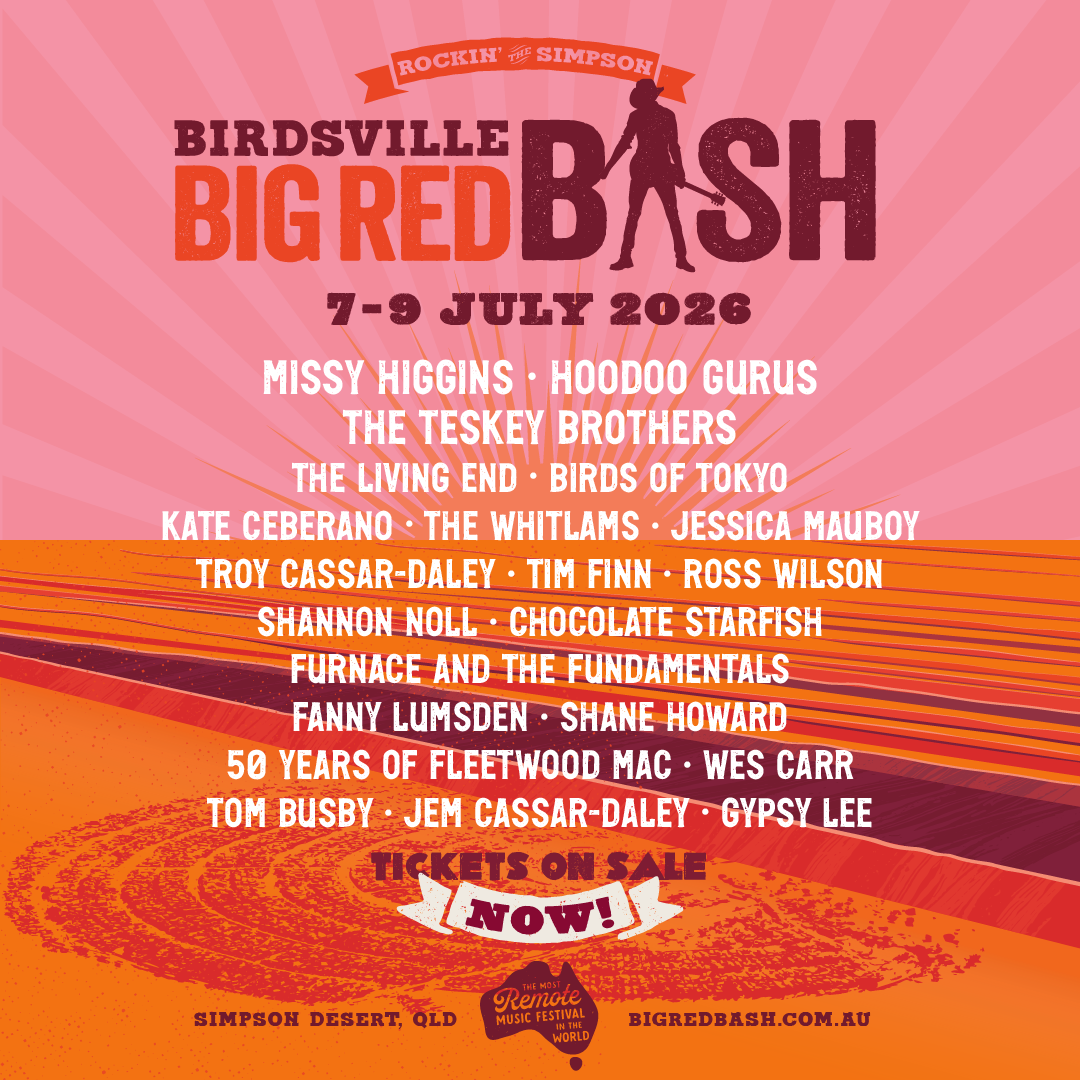
The cancellation of the Big Red Bash is the latest and clearest signal of converging issues in the live music industry.
Unprecedented flooding, after Birdsville received more than a year’s rainfall in days, made the site impossible to prepare in time, forcing the cancellation of a festival that was more than 90 per cent sold out.
Festival owner Greg Donovan and the Outback Music Festival Group have responded with clarity and professionalism, surveying patrons and partners, exploring relocation options and ultimately prioritising safety over costs as they decided to call off the event in 2026. Donovan said, “Mother Nature is the highest authority.” The industry has heard that message, and not for the first time. Earlier this month, Bluesfest — after 36 years — entered liquidation, leaving more than 20,000 ticket holders and over 2,000 contractors exposed, with $23 million in outstanding obligations.
The Big Red Bash delivers around $20 million annually into Outback Queensland. Bluesfest generated $230 million for the regional NSW economy in 2025 alone. These are not entertainment figures — they are regional economic lifelines.
These cancellations are symptoms of a deeper structural crisis driven by three compounding forces: climate volatility, escalating production and operating costs, and eroding consumer confidence.
Since 2004, average Australian festival ticket prices have risen by 180 per cent — twice the rate of inflation — not because demand is booming, but because promoters are attempting to absorb costs that continue to climb. Freight, crew, staging, security, insurance and fuel prices remain elevated, while audiences are increasingly price‑sensitive. When buyers also fear events may not proceed — or that refunds are unsecured — the model begins to fracture. The Bluesfest collapse has reinforced the urgent need for mandatory ticket trust arrangements to protect consumers and the small businesses that underpin the sector.
Climate change is no longer a contingency risk; it is a systemic one. Outdoor festivals depend on fixed dates, fixed locations and long lead times — assumptions that a destabilised climate increasingly undermines. Regional and remote events face the greatest exposure: relocation is rarely feasible, and local economies cannot absorb sudden cancellations. Climate adaptation is essential for live‑music infrastructure, including site resilience investment, climate risk assessments within event licensing, and financial safety nets when cancellations occur through no fault of operators.
Global instability compounds these pressures. Rising fuel prices linked to the ongoing conflict in the Middle East directly affect attendance and logistics for regional festivals and touring circuits that rely on long‑distance travel. Touring uncertainty increases risk, insurance costs and freight disruption across the global supply chain, with impacts felt even in the remote Queensland desert.
The decision to cancel Big Red 2026 was not failure; it was leadership. It demonstrated the level of responsibility the industry must now meet under intensifying pressure.
Protecting ticket revenue through trust mechanisms is critical to supporting consumers and the small businesses that form the backbone of Australia’s live music sector.
The ALMBC works with governments, promoters, insurers and industry partners to build a more resilient live music ecosystem — one capable of withstanding climate risk, economic shocks and global uncertainty without sacrificing trust, access or cultural value. That means ticket protections, transparent pricing, targeted support for Australian‑owned small and medium businesses (rather than internationally owned companies), and serious investment in regional touring networks.
Big Red will return in 2027. The ALMBC is working to ensure the industry it returns to is stronger, fairer and better prepared for the world we are all now operating in.