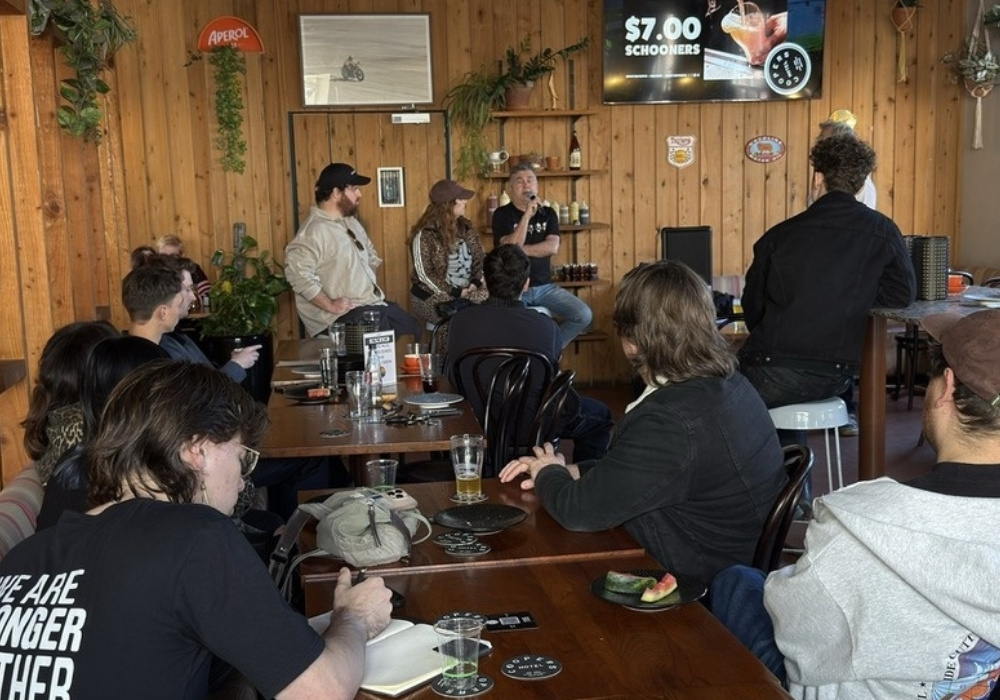
The closure of Lazy Thinking in Dulwich Hill has renewed calls to look at the influence property owners hold over Australia’s music venues, with operators and researchers pointing to weak tenancy protections as a major source of risk.
Lazy Thinking, a not-for-profit music venue in Sydney’s inner west, is closing after being asked to vacate by its building owners, according to founder Jim Flanagan. The venue had been on a month-by-month lease for years, and talks about the building’s infrastructure and a long-term lease went nowhere. Flanagan says Australia has some of the lowest rental protections in the developed world, which leaves music venues exposed as commercial tenants.
Similar lease outcomes have been reported for The Bearded Lady in Brisbane’s West End (May 2025), The Jade in Adelaide (January) and the Gasometer in Collingwood (March 2025), while the LGBTQ+ inclusive Divine Playhouse was moved out of a deconsecrated church in the Sydney CBD in July. MoshPit, Darling Nikki’s and Mary’s Underground in Sydney and Stay Gold, the Bendigo Hotel and Misfits in Melbourne have also announced closures this year, mostly citing financial pressures, although renting adds to the load when rents rise and bar sales fall.
RMIT University’s Dr Sam Whiting engaged with almost 100 venues, industry figures and stakeholders across Europe and the UK as a Churchill Fellow and found that owning the building was fundamental to long term sustainability.
Venues that owned their premises or held longer leases were able to plan ahead, weather challenges and apply for grants with greater success, and private property owners had little incentive to support that. His report points to Lazy Thinking as a recent example of a Sydney venue in the process of becoming a registered charity. Whiting has called for live music to be treated as a public good, similar to education or health, and recommends a community owned property model along the lines of the UK’s Music Venue Properties, a community benefit society owned by its members that buys the buildings housing grassroots music venues and rents them back to the operators on 25 year cultural leases, with any surplus reinvested in the venues. He also suggests governments could buy spaces or co-own them with venues, and his report recommends setting up an Australian equivalent of Music Venue Properties.
On the property side, Real Estate Institute of NSW chief executive Tim McKibbin says property owners are investors who want the maximum annual return and capital growth with no harm to their asset, and warns that restrictions would send investors elsewhere. The institute’s Victorian branch chief executive, Toby Balazs, says governments should focus on targeted incentives that encourage owners to retain and provide suitable spaces, rather than policies that penalise property owners or interfere with commercial agreements.
SydneyMusic co-founder Joe Hardy says many of the venues still operating are encouraged to act like larger spaces and book artists with broad appeal, so the space becomes a venue for hire without the continuity that builds a community.
Hacky Sack singer-songwriter Huck Hastings says his biggest shows in 2025 followed a gig at Lazy Thinking. The NSW Government has introduced vibrancy reforms including venue funding, and the Victorian and Queensland governments have announced grants for venues and local musicians, with NSW music minister John Graham saying “if we let our music venues fail then our night-time economies and our cultural life will suffer, and we can’t afford to let that happen”.
Flanagan says he will not reopen Lazy Thinking in anything like the same setup, and that a new venue would need an entirely different economic framework, possibly a government provided space or one offered by a donor at a discounted rent.