Industry comes together as ALMBC maps out next steps on super for musicians
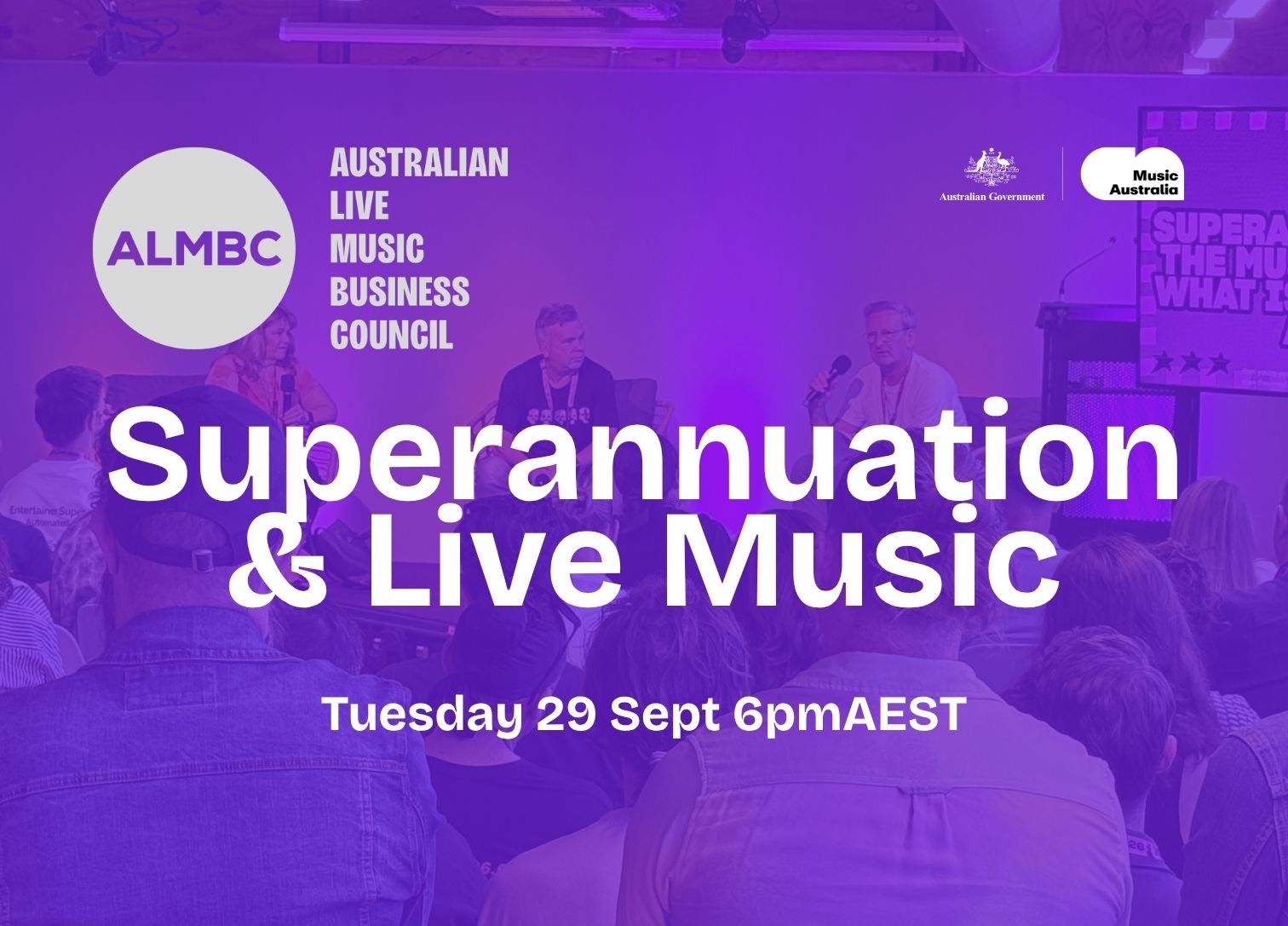
More than 280 people joined the Australian Live Music Business Council’s superannuation update session on Tuesday night, 29 September. It was the latest in a run of forums on the super obligations that now apply to musicians working as sole traders.
ALMBC Chair Howard Adams of music law firm Corner Soul hosted the session. He was joined by ALMBC Treasurer and music industry tax accountant Kylie Thompson of Sorrento Strategic, former ALMBC Chair Stephen Wade of Select Music, and Danielle Siers, Financial Controller at Music Victoria.
Watch the full video (with captions) here
(Unmute to listen)
Member Superannuation Survey
The session opened with early results from the ALMBC’s industry survey, which is still open till 5 October.
Musicians and the people who book them aren’t opposed to superannuation. The frustration is with the administration involved when the amounts being paid are so small.
92% of respondents want sole trader musicians treated the same way as any other sole trader, such as a plumber or electrician who sorts out their own super within their business.
83% said they would be comfortable with a hobby-style arrangement for people playing a handful of low-paid gigs, such as retirees or those already earning super through another job.
78% supported a de minimis rule, with a threshold below which super wouldn’t apply.
70% reported that the 12% is coming out of musicians’ own pockets, with fees now quoted as inclusive of super.
Respondents also reported work drying up. One regional New South Wales music venue has cancelled 150 gigs, and a long-running jazz festival cancelled the engagements of 322 sole trader performers.
Where the ATO is at
Musicians have been deemed employees for super purposes since 1992. The ATO’s view is that Payday Super, which started on 1 July, didn’t cause the problem but has made it far more visible. The removal of the $450 monthly threshold in 2022 had already widened the net.
Kylie took the audience through the ATO’s latest revisions, published on 28 August and 16 September. She noted that the most current guidance can be found by searching the ATO website for super for sports persons, which also covers performing artists. Key points included:
- In some circumstances a band leader can be treated as an agent for the band, with super paid to each member rather than to the leader alone.
- Where a fee covers significant costs, such as a $5,000 festival fee that includes $3,000 in travel and production costs, super applies only to the labour component.
- Ticket sales and door split arrangements between band members acting as a commercial venture don’t attract super. Kylie cautioned that clear written agreements are needed where a band leader distributes the takings.
- The ATO confirmed at a meeting in August that super is payable even where a statement by a supplier form is used.
- The ATO’s free Small Business Superannuation Clearing House closed on 30 June, leaving many small operators paying for software to meet their obligations.
Kylie has also raised errors in a checklist the ATO issued last Friday and is waiting on a response. The ALMBC will hold off sharing that document until it’s corrected.
The case for a de minimis threshold
Kylie outlined her proposal for a carve-out in tax law. Under it, super wouldn’t be payable on performance fees of $5,000 or less, with the threshold indexed to CPI. The change would need to go through Treasury and Parliament, since the ATO can’t change the law itself. She said the aim is to take the paperwork burden off the grassroots end of the industry so emerging artists and community festivals can keep going, while musicians working at a higher level move into company structures that pay super properly.
Stephen spoke about how varied the live music workforce is and the difficulty of fitting it into a one-size-fits-all system. He suggested the industry put together a large set of real-world examples showing where the current rules don’t work.
Danielle said many musicians haven’t had the chance to build the financial literacy the system now expects of them. She also floated a longer-term technology fix that would let payments and super flow through a government-run system.
Next steps
Howard said the industry now understands the issues well and it’s time to act rather than hold more forums. The ALMBC will:
- Finalise and share the survey report (after this closes on 5 October)
- Create a draft joint request, subject to the board’s view, focused on three or four key asks of government.
- Invite support and updates from across the industry, including other peak bodies and organisations.
- Share the request with the ATO, and take it to Treasury, the crossbench and interested members of Parliament.
The ALMBC will also go through the questions raised in the chat in last night’s session and publish answers to common ones on its website or in a special newsletter.
Kylie closed with a call for the whole music industry to get behind the push, even where people don’t agree on every detail, so that musicians and music venues around the country don’t keep losing gigs.
The content of the session, and of this summary, is general information only and isn’t financial, tax or legal advice. Please speak to a qualified professional about your own circumstances.
Member Questions During the Session
There was a stack of questions we didn’t get to – we are analysing these currently and will update these here.