Can Australian Music Survive in the Age of Spotify?
Victorian Budget restores Music Works, but the structural reform conversation is still to be had
The Victorian Government’s 2026/27 State Budget, handed down on 5 May, delivers $4.5 million for contemporary music initiatives, restoring Music Works alongside Songwriting in Schools and the Victorian Music Development Office after the program was axed in last year’s budget . The contemporary music line sits within an $81.1 million creative industries package, supported by $12.1 million for infrastructure upgrades to Hamer Hall, $1.2 million for regional touring, and $7.1 million over four years for state-owned cultural facilities.
Music Victoria has framed the package as “a stabilisation measure rather than structural support”, noting that underlying challenges remain at the grassroots and mid-tier levels where artists and the workforce are developed. The ALMBC shares this view.
Live music in Australia is a $4.83 billion revenue sector that drew an estimated 12 million attendees to contemporary live music events and festivals in 2023, the highest figure in 15 years. The broader Australian music industry generated $8.78 billion in revenue and contributed $2.82 billion in direct gross value added to the economy in 2023-24 . At the same time, the grassroots base of the sector continues to face significant pressure from rising operating costs, venue closures, and festival instability.
The ALMBC continues to advocate for structural reforms at the federal level that complement state-based funding programs like Music Works. Priority areas include insurance reform, grassroots venue support, best practice planning instrument development (such as Special Entertainment Precincts and more).
Regional and remote venues and touring remain a particular ALMBC focus. The Council has consistently made the case that rebuilding regional circuits is about “connection, culture, and resilience”, not entertainment alone . The Victorian Budget’s $1.2 million regional touring line is welcome, but it sits at the level of an annual top-up rather than the long-term structural commitment the regional sector needs to plan around.
The national benchmark for state-level investment continues to be NSW, where the 2025-26 budget locked in $20 million for Sound NSW alone, on top of a $103 million four-year contemporary music commitment, a 10-year Contemporary Music Strategy, and a mandated $250 minimum musician fee for publicly funded events . The Victorian package is roughly a quarter of NSW’s annual contemporary music spend. Victoria still doesn’t have an equivalent dedicated music agency or 10-year strategy locked in.
For the thousands of small and medium Australian businesses that make up the live music supply chain (venues, promoters, festival organisers, booking agents, ticketing companies, crews, security, and hospitality), the Victorian budget represents a return to previous investment rather than real progress.
The ALMBC will continue to advocate, across all levels of government, for the structural reforms that would put the sector on a sustainable footing, and for recognition of live music as the small-business engine room it actually is.
With the Federal Budget due 12 May, the WA and NT Budgets following shortly, and the NSW, SA, Qld and ACT Budgets all due in June, the ALMBC will continue tracking what each delivers for the live music sector.
Incredible finale with Peter Garret, The Presets and a stack of extra drummers!
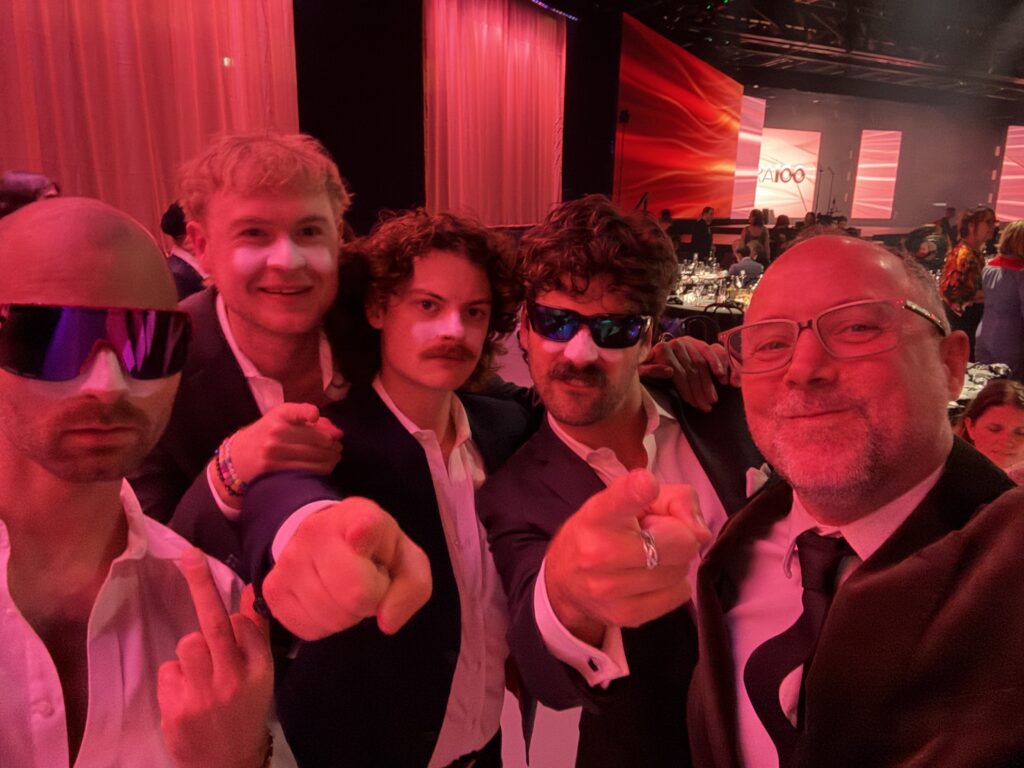
Playlunch & ALMBC EGM Ant McKenna